
Network Management / Supply Chain Design
Network management adds another layer of complexity to replenishment — but also a major source of savings and service improvement for companies that manage it well. The question is no longer only “how much should we buy?” but also “where should stock sit, when should it move, through which route, at what operational cost, and for which channel should it be protected?” A replenishment policy that works in one warehouse can become expensive or even wrong when applied across a network of distribution centres, stores, hubs, e-commerce stock, B2B flows and transport routes.
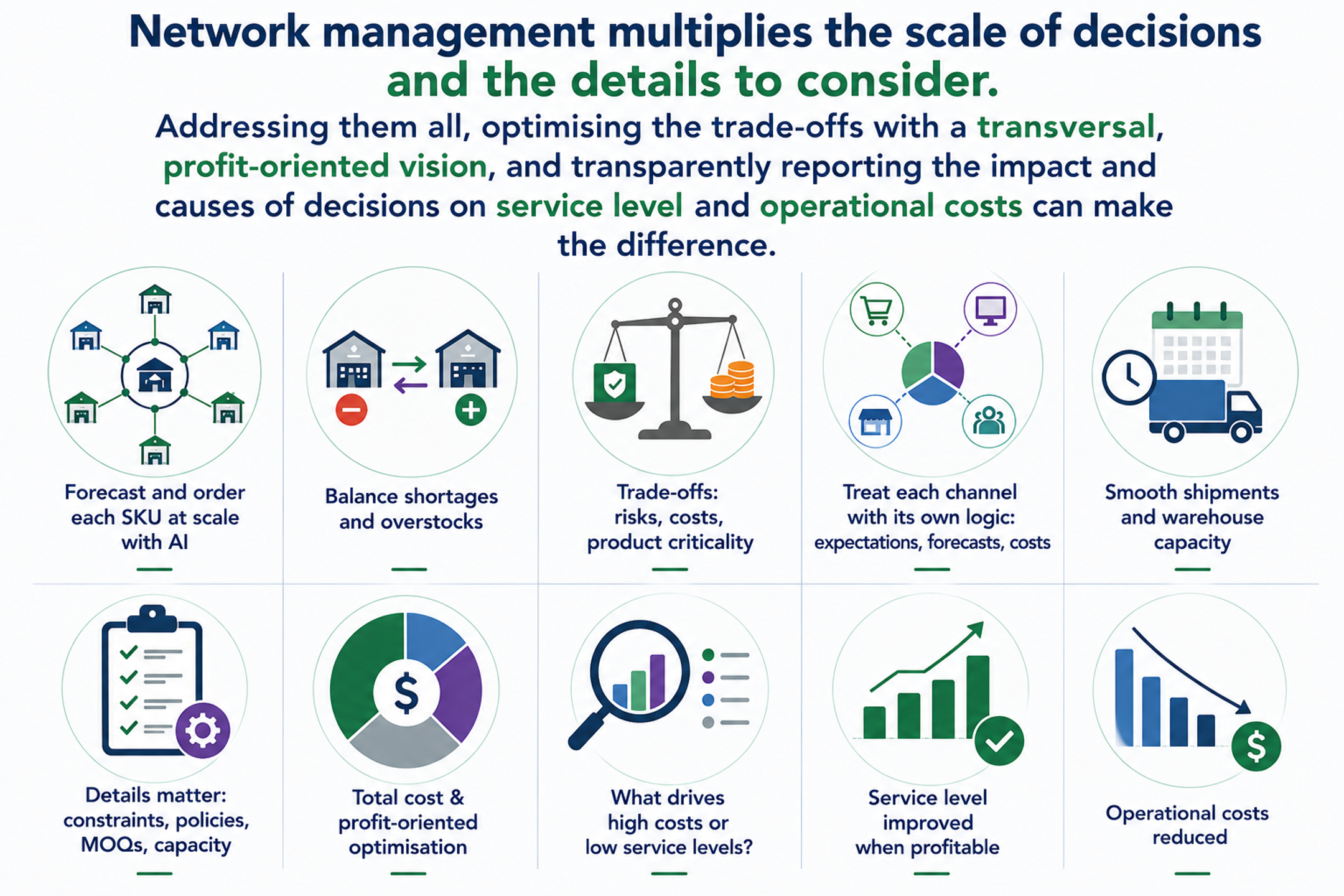
Nadii semi or fully automates the movements within a network, keeping in mind every decision has operational consequences and linked costs. Sending one unit every day may protect availability, but it can multiply picking, handling and transport costs. Sending seven units once a week may be cheaper, but it can increase local stock, reduce flexibility or arrive too late for demand. Supplying products linked to marketing campaigns too late creates missed sales; supplying them too early can overload distribution centres or freeze cash. The same replenishment decision can therefore be good or bad depending on transport schemes, picking costs, warehouse capacity, campaign timing, operational peaks and the role of each channel.
The opportunity becomes even more important when resources are scarce. If stock is limited, the right answer is not always to push products blindly into the network. Sometimes the best decision is to keep the right quantity at the distribution centre to protect e-commerce or strategic customers. Sometimes it is cheaper and faster to rebalance inventory between nodes than to place a new order. Sometimes a shipment should be advanced or delayed slightly to smooth the workload of a distribution centre, avoid operational peaks and reduce handling costs — provided that the financial impact and service risk are clearly understood.
Nadii treats the network as one decision system. It connects locations, channels, inventory, transport schemes, picking and handling costs, operational capacity, demand scenarios and business priorities in the same logic. The system can decide where stock should be placed, reserved, moved or replenished while taking into account both service impact and total operational cost. As usual in Nadii, these decisions are not hidden in the algorithm: their financial and operational impact is measured and reported, so teams can understand why a transfer, delay, acceleration, reservation or purchase was recommended and what result it created.
Multi-channel management
Different channels should not compete for stock under one averaged rule. Nadii manages e-commerce, retail, marketplaces, B2B, and strategic customers with separate logic for demand, service level, reservation rules, and operational priority. Each SKU can be analysed in the context of a specific channel and location, with its own forecast, service expectation, and reservation logic. This allows the system to protect stock where commitments are stricter, shift priorities when channel risk changes, and keep decisions aligned with how each channel really drives sales, margin, and workload.
Inventory balancing across locations
Nadii continuously checks whether shortages in one location can be covered by excess stock elsewhere before suggesting new purchases. It compares transfer options across warehouses, stores, hubs, or channel-specific stock and recommends reallocation when it is faster, cheaper, or operationally safer than buying more. This is not a manual balancing exercise run from time to time. The system recalculates continuously as stock positions, demand, lead times, and channel priorities evolve, so the network uses what it already has more intelligently before locking more cash into new supply.
Decision making based on overall costs
In a network, the cheapest local decision is often not the best network decision. Nadii evaluates each move — buy, transfer, reserve, delay, accelerate, or reallocate — against total cost: stockout risk, excess stock, transport, handling, working capital, channel penalties, service commitments, and operational constraints. This allows the system to choose the option that improves the overall business result, not just one local KPI. In practice, that means better service where it matters most, fewer unnecessary purchases, and lower hidden logistics costs without losing control of margin or availability.
Operations-aware network replenishment
Network replenishment should not be disconnected from the cost of execution. A decision that looks optimal from a stock perspective can create unnecessary transport, too many picking lines, peaks in distribution centres or inefficient delivery rhythms. Nadii includes these operational constraints directly in the decision: transport schemes, shipment frequency, picking and handling effort, warehouse capacity, campaign timing and expected workload at each node.
The system can therefore decide not only how much stock is needed in each location, but also how to move it through the network with the lowest total impact. It can compare whether it is better to send smaller quantities more often or consolidate shipments, whether a delivery should be advanced or delayed to avoid overloading a distribution centre, and whether a temporary service risk is acceptable compared with the operational cost avoided. This is especially important before marketing campaigns, seasonal peaks or known operational bottlenecks, where the timing of stock movement can be as important as the quantity itself.
Actionable network reporting: from cost to source decision
In network replenishment, the difficulty is not only to see that an overstock, lost sale or higher operational cost appeared. The real challenge is to understand which movements and decisions created it. With several nodes, channels, transfers, reservations and campaign constraints, the root cause can be hidden several steps back: a product sent too early, stock kept at the distribution centre to protect e-commerce, a delayed transfer, a manual override, or a purchase made instead of balancing inventory already available in the network.
Nadii retraces the chain of decisions that led to the current stock level in a specific node: purchases, transfers, reservations, accelerations, delays, automatic decisions and user changes. It links these movements to their operational and financial impact — transport cost, picking effort, warehouse workload, availability, margin and cash tied in stock. Reporting therefore becomes actionable: users do not only see the deviation, they understand its cause and can improve the next decision.
Let's talk!
Leave your details and we’ll get back to you within 24 hours to arrange a short online meeting (around 20–30 minutes). You can also tell us what you need straight away, and we’ll tailor the conversation to your situation.
Would you rather email us?
Email us at contact@nadii.io