
S&OP / Budget Planning / Digital Twin
Budget planning and S&OP often fail for a simple reason: companies need a clear, simple decision process, but the truth behind the plan sits in thousands of operational details. A budget may look coherent at category or monthly level, yet the real result depends on much more granular drivers: demand uncertainty per product, supplier lead times, payment terms, capacities, transport constraints, price changes, promotions, product mix, service targets… These drivers are often scattered across different functions of the company. The most important resources to plan — for example sensitive raw materials, bottleneck machines, critical skills or cash tied in stock — are often the aggregated consequence of many small product-level or market-level scenarios.
This creates three recurring problems.
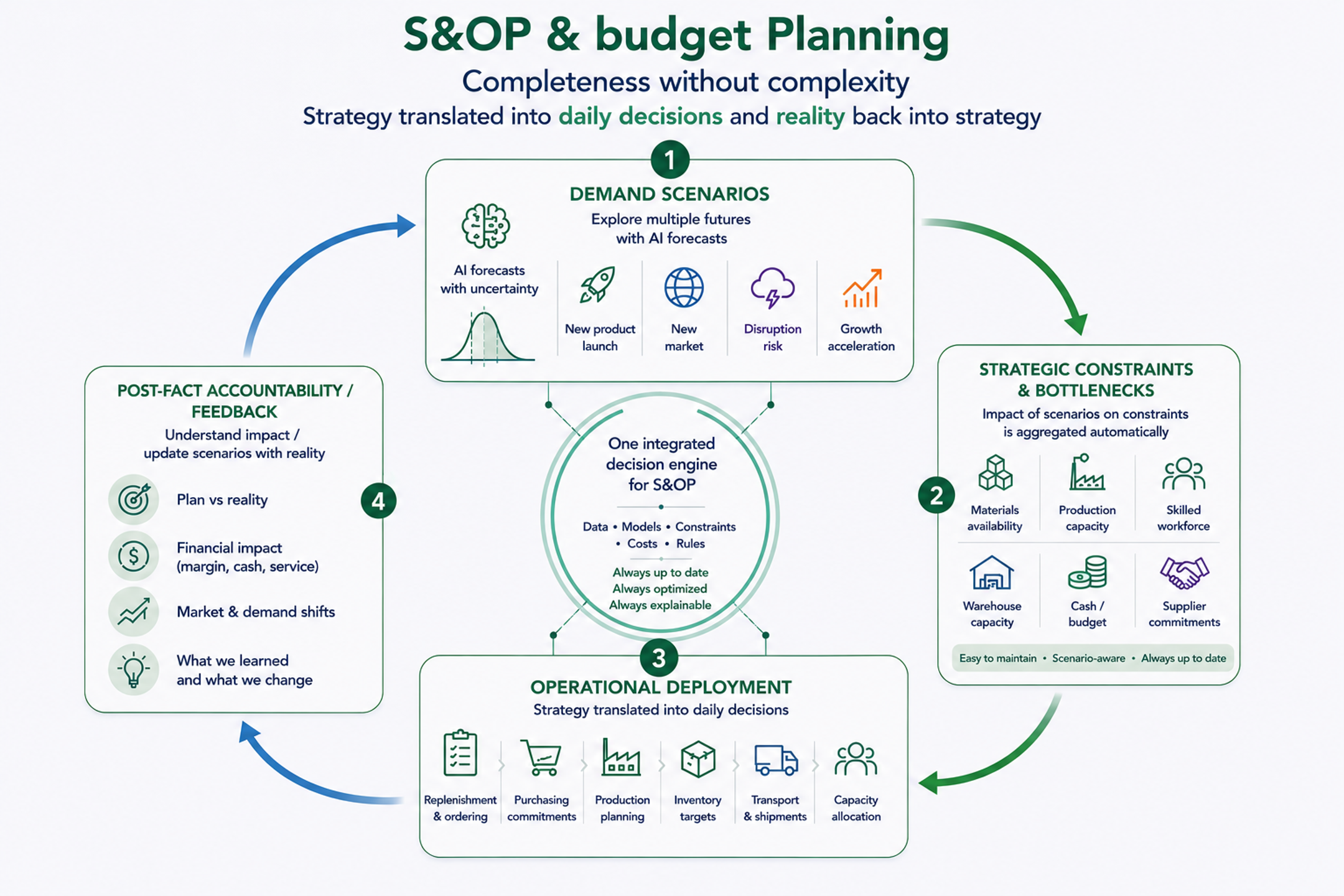
First, accountability becomes weak: when the budget is wrong, teams can see the variance, but they struggle to explain what caused it. Was the issue forecast accuracy, supplier delay, a wrong assumption on product mix, a campaign effect, a capacity constraint, a purchasing decision, a price change or a manual adjustment?
Second, the S&OP process becomes either too simplistic to be useful or too complex to be manageable. If the process stays high-level, it misses the operational constraints that actually determine feasibility and margin. If it goes into every detail manually, meetings become heavy, slow and impossible to scale.
Third, the lack of connection between high-level scenarios and low-level decisions makes it hard to transpose strategic decisions into real day-to-day execution, especially when execution is split across different departments.
The real challenge is therefore not only to build a budget or run an S&OP meeting. It is to make strategic decisions while keeping the process simple, explainable and connected to operational reality. Decision-makers need to test scenarios, but not only as abstract “best case / worst case” assumptions. They need to understand how different demand and supply scenarios would consume critical resources, change inventory levels, affect supplier commitments, move cash flow, create bottlenecks, increase operational costs or protect margin.
Nadii answers this challenge because it natively works with probabilistic forecasts, scenarios and detailed supply chain constraints, therefore never breaking the link between low-level constraints and high-level decisions. It connects data from different company departments — marketing plans, budgets, operational constraints, purchasing conditions — and from available company systems: demand, inventory, suppliers, lead times, payment terms, prices, transport, warehouse capacity and operational rules. It then turns them into decision-ready scenarios. This allows teams to consider the details that matter at scale without turning S&OP into a manual modelling exercise.
Nadii supports S&OP, budget planning and Digital Twin simulations as one connected decision layer. Teams can compare scenarios, quantify trade-offs, explain gaps between plan and reality, and understand the likely financial and operational impact of strategic choices before they are pushed into daily execution. The result is not another planning file, but a planning process that stays simple at management level, is easy to deploy into daily operations, and remains grounded in the operational details that actually drive cost, service, cash flow and margin.
Strategic decision-making through S&OP
Nadii supports S&OP as a decision process rather than a reporting ritual. It brings demand expectations, supply constraints, inventory implications, capacity limits, and service targets into one model, so teams can compare realistic scenarios before committing to them. This is useful when the business must choose between competing priorities such as higher availability versus lower inventory, growth ambitions versus constrained capacity, or better supplier terms versus more working capital tied in stock. Instead of discussing these trade-offs in the abstract, Nadii shows their likely operational and financial consequences.
From S&OP scenario to operational execution
In difficult planning contexts — geopolitical disruptions, new markets, product launches, long-term forecasts or major strategic shifts — the scenario chosen at S&OP level may not always be the most probable scenario according to the data. Management may deliberately decide to cover a less likely but strategically important scenario: securing a launch, protecting a key market, preparing for a supply risk, or reserving capacity for growth. The challenge is that this decision must not remain a slide, a meeting note or a high-level assumption. It must be translated into real operational decisions: raw material orders, finished goods purchasing, inventory buffers, capacity planning, supplier commitments, warehouse workload and transport plans.
This is where many S&OP processes break down. A strategic scenario is approved, but day-to-day systems continue to optimise against the baseline forecast, or each department interprets the decision differently. Nadii prevents this gap by keeping the link between high-level scenarios and low-level execution. When a scenario is selected or overridden at S&OP level, Nadii can embed it into operational decision logic so that replenishment, purchasing and planning decisions are made consistently with the chosen strategy.
At the same time, Nadii keeps the impact measurable. If the business deliberately covers a scenario that was not the most probable one, the system tracks the operational and financial consequences of that choice: additional stock, protected sales, avoided shortages, increased capacity usage, higher warehousing or transport costs, margin impact and cash flow effect. Once the future becomes the present, teams can compare the scenario, the original AI recommendation, the human override and the actual outcome. This creates a learning loop: strategic decisions are not only executed, but also evaluated afterwards, so the organisation understands what the decision really cost, what it protected and how future S&OP choices should be improved.
Predictable and explainable cash flow planning
Cash flow is shaped by day-to-day supply chain decisions, but in many companies that connection is not visible early enough. Nadii makes it explicit. The system links replenishment policies, inventory targets, supplier offers, buying opportunities, campaign timing, and service ambitions to their likely impact on working capital and future cash flow. This allows finance and operations to work from the same logic: not only seeing that cash requirements will change, but also understanding which specific decisions are driving that change.
Budget planning linked to operational reality
Nadii connects budget planning with what the supply chain can actually deliver: forecast demand, supplier lead times, inventory limits, transport costs, warehouse load, and service targets. This makes the budget more realistic from the start. The logic also works in reverse — because Nadii continuously captures operational behaviour, market dynamics, and demand and supply forecasts, it can provide a reliable budget baseline and a strong data-driven input for finance teams and CFOs.
Supply Chain Digital Twin: test new scenarios without risking daily operations
Nadii’s Digital Twin provides a safe environment to test changes before applying them to live operations. Teams can simulate alternative replenishment policies, different stock targets, new service objectives, supplier changes, network redesigns, transport assumptions, or more aggressive buying strategies. This is especially valuable when a company wants to move fast but cannot afford trial-and-error in real operations. Instead of discovering the consequences after implementation, the business can compare scenarios in advance and understand the likely impact on stock, service, warehouse workload, transport cost, and cash flow — without disrupting the daily flow of orders and deliveries.
Let's talk!
Leave your details and we’ll get back to you within 24 hours to arrange a short online meeting (around 20–30 minutes). You can also tell us what you need straight away, and we’ll tailor the conversation to your situation.
Would you rather email us?
Email us at contact@nadii.io