
Product Portfolio Management
“Where should we free the next euro of cash, and where should we allocate it to get the best return on investment?” This is what Nadii users should be able to answer at any time.
Product portfolios rarely become complex in one big decision. They become complex gradually: one launch, one local exception, one customer-specific reference, one replacement product, one seasonal item, one private-label alternative, one kit, one “temporary” SKU that stays active for years. Over time, the assortment grows, more and more cash gets frozen, and the logic behind each product becomes harder to see. Some items drive margin or strategic availability. Others mainly consume shelf space, warehouse capacity, working capital and planning attention.
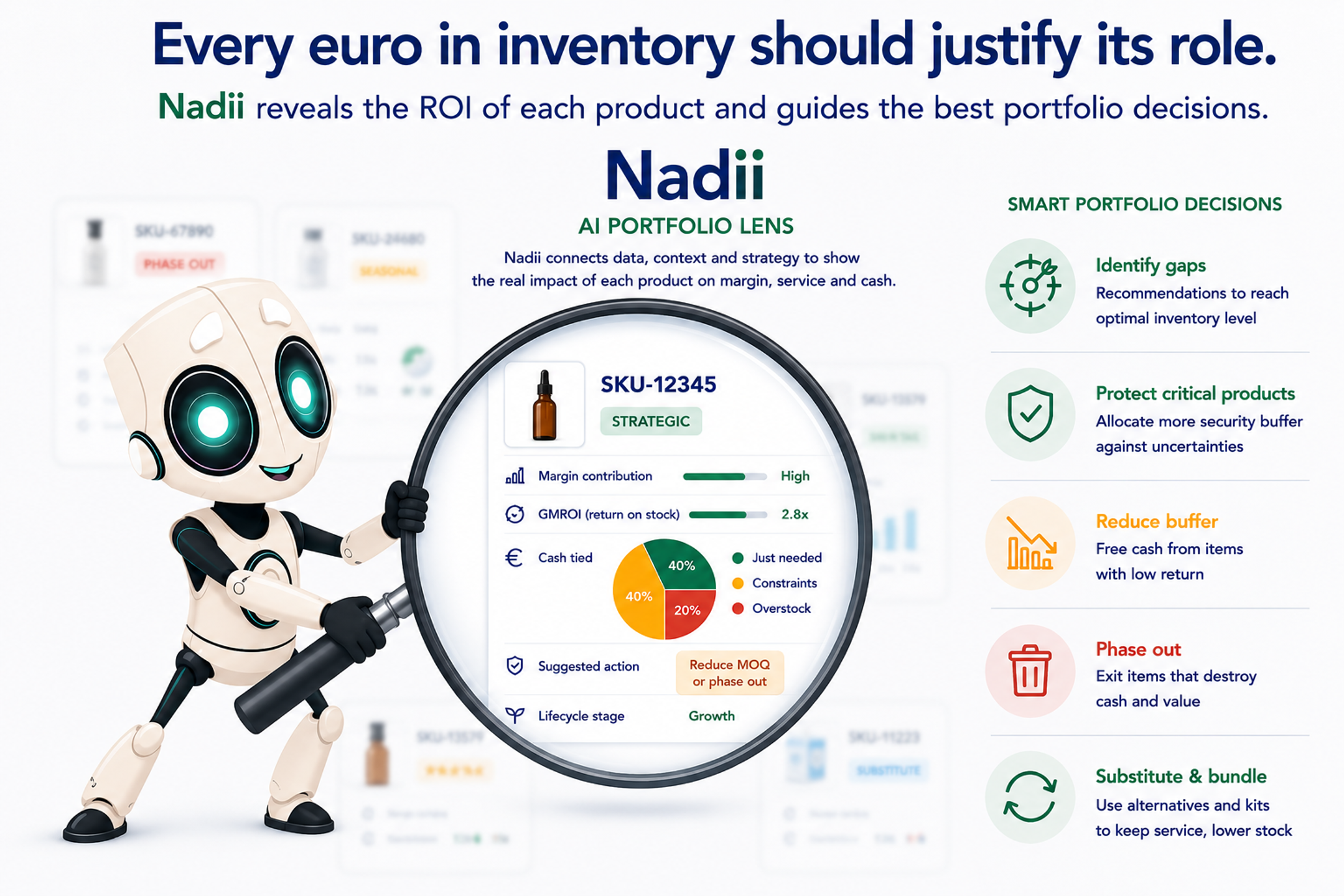
This is why managing a portfolio with one averaged rule quickly becomes dangerous. A slow mover is not always a bad product. A high runner is not always strategic. Nadii manages product portfolios as a living decision system, not as a static classification exercise. It calculates the return on investment of each euro in inventory and transparently reports the ROI of each product, location and channel across lifecycle stages, so users can make accurate business decisions without having to rebuild the financial logic manually.
It distinguishes active, sell-through, on-demand and discontinued logic; links replenishment behaviour to product criticality; and takes into account shelf life, substitutes, kits, components and local demand patterns. Instead of treating every product with the same replenishment and reporting logic, Nadii adapts the decision to the real business role of the item.
Control the return on investment of each euro in your inventory
Inventory is not only stock — it is invested cash. Nadii helps teams understand whether that cash is working hard enough by linking inventory value to margin, sales contribution, service role and operational cost. Using indicators such as GMROI — gross margin return on inventory investment — the system can show which products, locations or channels generate a healthy return, and which ones mainly freeze cash without contributing enough to the result — from an aggregated portfolio view down to product, location and channel detail.
This makes portfolio decisions more precise, faster and easier to explain. A slow-mover may still deserve protection if it secures a strategic customer, completes an offer or protects availability. But a product that consumes working capital, shelf space and planning effort without generating enough margin becomes visible as a candidate for sell-through, status change, reduced buffer or discontinuation. Nadii helps teams release cash tied up in products that do not create enough value, and redirect it toward new launches, strategic products, higher-margin ranges or items where additional inventory can genuinely improve service and profit.
Product status by SKU and by location
Nadii manages product status where decisions are actually made: by SKU and by location. A product can be active in one site, sell-through in another, on demand in a third, or discontinued elsewhere, depending on local demand, service needs, and portfolio strategy. These statuses are not static. Nadii updates the underlying logic continuously as sales patterns, stock positions, channel priorities, and local conditions evolve, so replenishment, reporting, and operational decisions stay aligned with the real role of each product in each location.
Product lifecycle: launch, season, phase-out
Nadii manages the product lifecycle as a living process rather than a one-off classification. It supports launch ramp-up, seasonal availability, and controlled phase-out, and keeps adjusting decisions as demand, sell-through, and market conditions evolve over time. This means inventory logic, ordering rhythm, and monitoring do not stay frozen once a product is labelled as a launch or seasonal item. Nadii continuously adapts the policy to the current stage the product is actually in.
Shelf life and loss prevention
For products with expiry constraints, Nadii helps reduce loss before the problem becomes visible too late. The system continuously monitors shelf life, identifies the last safe ordering moment, and updates recommendations as stock ages, demand changes, or rotation slows down. When needed, it can support transfer decisions, controlled depletion, or a change in replenishment behaviour so the business protects availability without creating avoidable write-offs. This is especially valuable where ageing stock creates hidden cost and late reaction is expensive.
Substitutes, kits, and light assembly under control
Nadii supports assortments where products are not independent from one another. It manages substitute logic, connects kit demand with component demand, and supports simple assembly or completion flows where one missing part can block the final sale or use. These relationships are monitored continuously, so when component availability, substitution patterns, or demand priorities change, the system updates the recommendation accordingly. Instead of planning finished products and components separately, Nadii keeps them in one coherent and continuously updated decision logic.
Let's talk!
Leave your details and we’ll get back to you within 24 hours to arrange a short online meeting (around 20–30 minutes). You can also tell us what you need straight away, and we’ll tailor the conversation to your situation.
Would you rather email us?
Email us at contact@nadii.io