
Nadii is an AI platform that makes thousands of supply-chain decisions every day — faster, with greater consistency, and with business impact built into every recommendation.
AI-Powered Optimization
for Your Supply Chain
and Beyond
-v2.avif)



-v4.avif)
-v3.avif)
Built to understand complex, unpredictable markets.
Unpredictability is now the norm: weather, epidemics, raw-material prices and exchange rates all affect demand and supply.
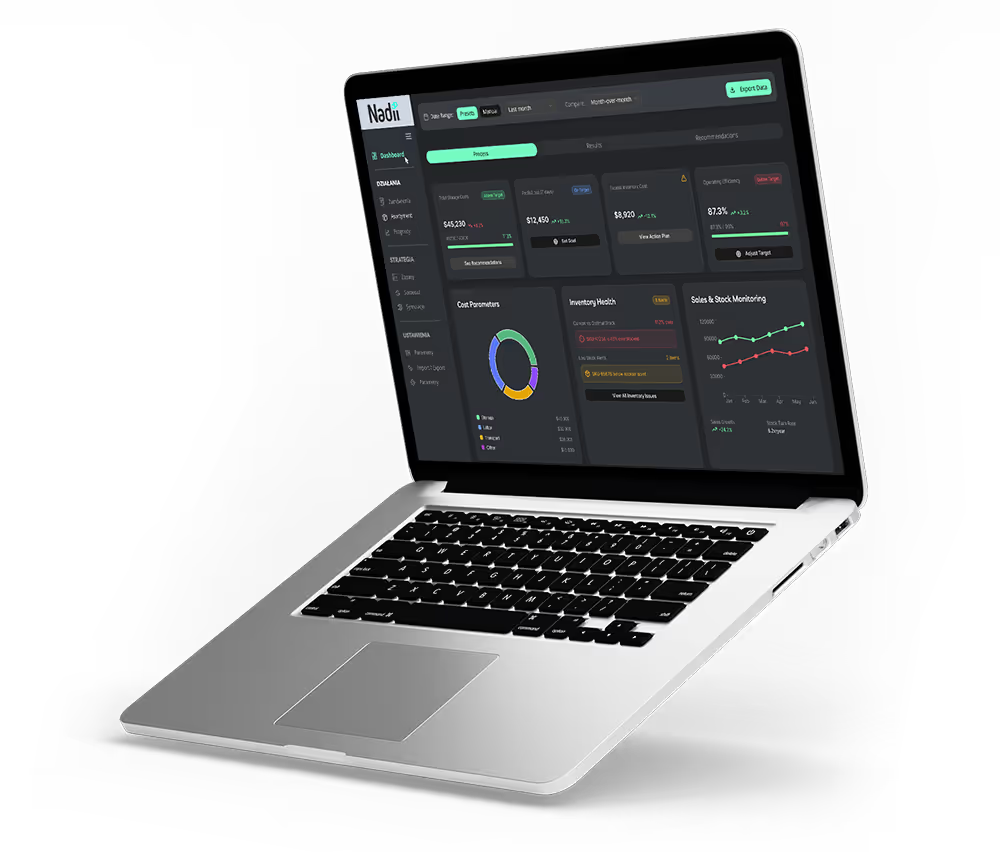
Nadii models this uncertainty probabilistically, automates micro-decisions such as orders, allocations and schedules, and continuously steers margin and inventory levels. It shows the impact of each decision on availability and working capital — ultimately improving financial performance and profit.
Why Nadii?
Behind Nadii is more than 20 years of experience creating machine learning-powered tools — long before AI became a mainstream acronym.
Every day, your sales and operations teams make thousands of decisions. But how can you ensure those decisions use available capital in the best possible way under current conditions?
The challenge
Excel and systems based on fixed parameters cannot keep up, leading to excess inventory, stockouts, warehouse and transport bottlenecks, and rising costs.
Our approach
We also account for real business constraints such as available cash, SLAs, time windows and operational capacity. The model connects micro-decisions into a coherent macro outcome aligned with management strategy.
What you gain
- Management sees how operations will impact P&L and inventory — in advance.
- Operations get ready-made recommendations and understandable KPIs.
- The pressure of choosing between profit and availability disappears — we know which stock maximizes the result.
Availability or inventory?
Profit should decide.
The challenge
Excel and systems based on fixed parameters cannot keep up, leading to excess inventory, stockouts, warehouse and transport bottlenecks, and rising costs.
Our approach
- We forecast demand and supply, including lead times, availability and risk.
- We identify the impact of special events to improve forecast accuracy.
- We provide probabilistic scenarios instead of a single number.
- We combine costs and benefits with those probabilities to choose decisions that remain robust across different future scenarios.
Examples of policies:
Before peak season, we order slightly earlier to reduce operational peaks and supplier-delay risk. At the end of the season, we automatically reduce orders for slow-moving SKUs when the cost of excess inventory outweighs the value of a few potential sales.
What you gain
- Fewer stockouts and excesses, with smoother warehouse and transport operations.
- Higher margin, better use of capital and more stable cash flow.
- Instead of reacting after the fact — proactive control of business outcomes.
A common language across the organization
The challenge
- Different departments focus on different KPIs, while the common “why” behind an outcome — excess inventory or a shortage — is often missing.
How we respond
- Interactive reports explain the root cause: forecast error, deliberate smart buying, a demand shift or a supplier delay.
- A management-level macro view combines with operational drill-downs, using consistently defined KPIs across sales, purchasing and logistics.
What you gain
- Decisions based on facts rather than intuition.
- Aligned objectives across departments and faster action.
- Manage outcomes — margin and period-end inventory — in advance, before they appear in financial reports.
Results that make a difference
through less handling and transport, fewer emergency replenishments and shortage-related costs, and lower inventory carrying costs.
stocks
by automatically limiting free-moving SKUs, while maintaining or improving product availability.
availability
with optimal inventory levels, thanks to forecasts resistant to market volatility.
Examples of successes achieved with Nadii
Automotive customer
availability of critical products
obsolete inventory
inventory value and faster turnover (+30%)
Healthcare sector
availability of critical items
depreciation due to overdue payments
urgent procurement (CITO) and ad hoc procurement
FMCG customer
inventory level on MC and (-35%) in the network
on-shelf availability (OSA) with minimal inventory
gross margin
lost sales
Feedback from our customers
Nadii combines cost and risk with availability. Micro-decisions are arranged into a macro-result: fewer shortages, fewer surpluses and an even rhythm of warehouse and transport work.
Logistics Director
Automotive
Management finally sees ahead of time what will happen at P&L. Transparent reports show the genesis of every decision — from planning errors to smart-buying to supplier delays. Finally we have one language between departments.
CFO
Medical Industry
Nadii runs SKU statuses and life cycles. The system itself “rolls” the tails of slow-rotating products at the end of the season, and smart-buying protects the margin. The result: less dead stock and more stable cash flow.
Director of Supply
Automotive
After giving up Excel sheets, planning goes twice as fast, and inventory has dropped by 20-40%. Finally, we have time to develop, not to rewrite and control tables.
Owner
E-commerce
From deterministic “constant parameters” we switched to probabilistic with risk assessment. Purchasing and allocation decisions are consistent between e-commerce and stores. Thanks to this, we have fewer peaks in current work and more fluid operations.
Purchasing Director
FMCG
The combination of more effective S&OPs and daily micro-decisions made by Nadii has drained the warehouses by millions of zlotys of capital equivalent, without losing the level of service.
Director of SCH
Automotive
Automatic refills and clear SKUs prioritized reduced shortages by 40-50%, without generating excess statuses — at more than 200 locations.
Director of SCH
FMCG
Nadii synchronized promotions with real profit. No more “cheap” sales that ended with a lack of goods. In addition, the processing time of orders was reduced by about 25%, and the products from the new offer gained 5-10 pages of availability.
Vice President
FMCG
We stopped choosing between availability and stock. Today we know which stock maximizes margin and cash flow. Depending on the commodity, inventories decreased by 15-20% and availability increased by 1-3%.
Owner
Wholesaler
Nadii combines cost and risk with availability. Micro-decisions are arranged into a macro-result: fewer shortages, fewer surpluses and an even rhythm of warehouse and transport work.
Logistics Director
Automotive
Management finally sees ahead of time what will happen at P&L. Transparent reports show the genesis of every decision — from planning errors to smart-buying to supplier delays. Finally we have one language between departments.
CFO
Medical Industry
Nadii runs SKU statuses and life cycles. The system itself “rolls” the tails of slow-rotating products at the end of the season, and smart-buying protects the margin. The result: less dead stock and more stable cash flow.
Director of Supply
Automotive
After giving up Excel sheets, planning goes twice as fast, and inventory has dropped by 20-40%. Finally, we have time to develop, not to rewrite and control tables.
Owner
E-commerce
From deterministic “constant parameters” we switched to probabilistic with risk assessment. Purchasing and allocation decisions are consistent between e-commerce and stores. Thanks to this, we have fewer peaks in current work and more fluid operations.
Purchasing Director
FMCG
The combination of more effective S&OPs and daily micro-decisions made by Nadii has drained the warehouses by millions of zlotys of capital equivalent, without losing the level of service.
Director of SCH
Automotive
Automatic refills and clear SKUs prioritized reduced shortages by 40-50%, without generating excess statuses — at more than 200 locations.
Director of SCH
FMCG
Nadii synchronized promotions with real profit. No more “cheap” sales that ended with a lack of goods. In addition, the processing time of orders was reduced by about 25%, and the products from the new offer gained 5-10 pages of availability.
Vice President
FMCG
We stopped choosing between availability and stock. Today we know which stock maximizes margin and cash flow. Depending on the commodity, inventories decreased by 15-20% and availability increased by 1-3%.
Owner
Wholesaler
Let's talk!
Leave your details and we’ll get back to you within 24 hours to arrange a short online meeting (around 20–30 minutes). You can also tell us what you need straight away, and we’ll tailor the conversation to your situation.
Would you rather email us?
Email us at contact@nadii.io