
Production Planning & Assembly Management
Production planning breaks down when reality becomes more complex than the planning file. Every day, manufacturers make thousands of microdecisions: what to produce, when, on which line, from which batch of material, in which sequence, and for which customer priority. Each of these decisions affects service level, stock, capacity, labour, cash flow and margin. Yet in many factories, planning still depends on static rules, Excel adjustments and manual coordination between production, procurement, logistics, sales and finance.
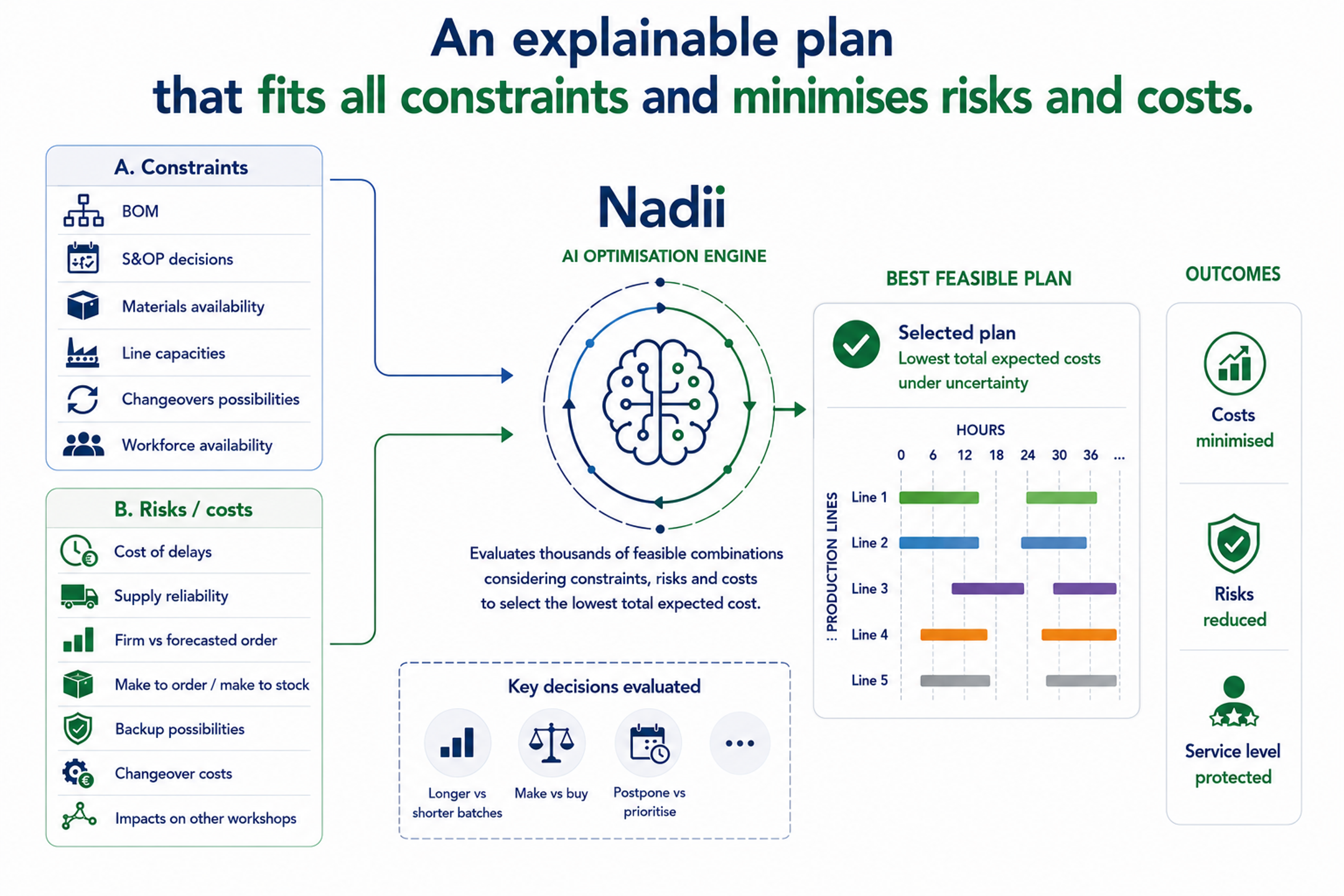
The difficulty is not only demand variability. It is the combination of constraints that change at the same time: frequent changeovers, short production runs, multi-level BOMs, limited machine and workforce capacity, long component lead times, supplier uncertainty, shipping windows, warehouse workload, customer priorities and different production policies such as make-to-stock, make-to-order or hybrid models. A plan can look coherent at MPS or MRP level, but fail on the shop floor because one component is missing, one bottleneck is overloaded, one campaign was not prepared early enough or one supplier delay was underestimated.
The central question is therefore not only “what should we produce?”. It is: what is the best production decision when every option has a different operational and financial consequence? Producing earlier may protect availability but increase stock and cash pressure. Producing later may reduce inventory but create service risk. Increasing batch size may reduce changeovers but overload the warehouse. Outsourcing may protect capacity but increase cost or quality risk. Buying more components may secure production, but only if the expected demand, supplier conditions and cost of capital justify it.
Nadii turns production planning and assembly management into a cost-probabilistic decision system. It connects demand and supply forecasts, confirmed orders, BOMs, supplier lead times, material availability, capacity limits, changeover costs, workforce constraints, shipping windows and financial impact in one logic. The system helps decide what to produce, when, where, with which materials and whether to make or buy — not as a static plan, but as a continuously updated decision process grounded in real factory, warehouse and market conditions.
Smooth production instead of workload peaks
Production becomes unstable when orders, material arrivals, changeovers and shipments accumulate in the same operational windows. A plan that looks efficient on paper can create peaks on lines, congestion in the warehouse, overtime, urgent shipments and missed dispatch slots. When demand suddenly changes, a component arrives late, a machine becomes unavailable or a customer priority shifts, the whole sequence can be disrupted.
Nadii reduces these avoidable peaks by combining short-term execution logic with longer-term probabilistic forecasts, so planning is not based on one fixed future but on multiple demand and supply scenarios with their probabilities. The system takes into account line and shift capacity, changeover times, material availability, workforce constraints, warehouse and production workload, shipping slots, as well as customer and product sensitivity. Each plan can therefore be evaluated not only as possible or impossible, but also through its risk and cost: producing a batch earlier or later, making it bigger or smaller, splitting it, consolidating it, outsourcing it or keeping it in-house all have different consequences.
Optimising all these criteria manually is extremely difficult, because the effect of moving one work order is rarely local. It can change component availability, line sequence, warehouse workload, dispatch timing, service level, margin and future capacity. Nadii’s core cost-based and probabilistic approach allows the system to sequence orders to reduce changeovers, move production or dispatches to earlier or later windows, consolidate batches into efficient logistics units and smooth the workload without losing availability — while minimising global cost rather than one isolated operational metric.
This dynamic approach is vital in production environments. Scheduling must remain agile enough to absorb last-minute issues, but stable enough to avoid creating permanent firefighting. Nadii helps keep that balance: it adapts quickly when conditions change, while preserving an overall workload profile that production, warehouse and logistics teams can actually execute.
Materials on time: BOMs, alternatives and smart buying
One missing component can stop an entire production run. In complex BOM environments, the risk is multiplied: a finished product may depend on many levels of components, substitutes, suppliers, minimum order quantities and lead times. Protecting every component with high buffers is expensive, but under-protecting one critical part can block sales, waste capacity and destabilise the plan.
Nadii links the production plan directly to material risk. It monitors component availability, supplier reliability, lead time uncertainty, MOQ, packaging rules, alternative suppliers and substitute materials. The system detects the risk of shortage early, identifies the last safe ordering moment and dynamically adjusts production priorities when a missing part could block a batch.
Smart buying is handled through the same logic. Nadii does not buy more only because a supplier offers a discount. It compares thresholds, price changes and supplier conditions with real demand, component criticality, production needs, cost of capital, freight and overstock risk. This helps teams secure materials on time without buying blindly or treating all components with the same level of protection.
What to make to stock, what to make to order, and when to make or buy
Not every product should follow the same production policy. Fast-moving items may justify make-to-stock with dynamic buffers. Variable or niche products may be better handled through make-to-order. Some products may require hybrid logic: keeping semi-finished stock while final assembly, packaging or configuration is triggered by demand. In parallel, companies must decide when to manufacture internally and when it is better to outsource.
These choices are often difficult because they depend on changing demand, margin, service expectations, line occupancy, changeover cost, workforce availability, component risk, subcontractor lead time, quality risk and transport cost. A rule that was right last quarter may become wrong when demand slows down, capacity becomes scarce, supplier reliability changes or a subcontractor becomes more competitive.
Nadii recalculates these policies continuously. For each product, channel or customer priority, the system evaluates whether the best option is make-to-stock, make-to-order, hybrid execution, make internally or buy externally. The decision is based on expected demand scenarios, risk of lost margin, cost of excess stock, capacity consumption, bottleneck impact, material availability and supplier alternatives. When conditions change, the policy adapts — with a clear explanation of why the recommendation changed.
Launches, seasonality and campaigns aligned with production
Product launches, seasonal peaks, campaigns and price changes can destabilise production when commercial plans and operational capacity are not connected early enough. Sales may expect a strong launch, marketing may create a demand peak, procurement may still be waiting for components, and production may discover too late that capacity or material availability is insufficient.
Nadii connects demand drivers with production reality. It links campaign calendars, expected sales uplift, product positioning, seasonality, confirmed orders, component availability, line capacity, warehouse workload and shipping windows. When the risk of shortage increases, the system can propose earlier production, material acceleration, campaign pacing, allocation changes or priority adjustments. When demand weakens, it can reduce future batches, combine variants, slow replenishment and protect margin.
This makes production and sales work from the same operational truth. Campaigns are no longer planned as isolated commercial events; they are translated into material needs, capacity consumption, stock targets and dispatch plans before execution is already under pressure.
One shared view from S&OP to the shop floor
Production planning often fails because teams work from different versions of reality. Sales sees demand. Procurement sees supplier risk. Production sees capacity and changeovers. Logistics sees dispatch constraints. Finance sees cash, margin and inventory value. When these views are not connected, decisions are delayed, priorities conflict and the real cause of performance gaps becomes hard to trace.
Nadii gives planning, production, procurement, logistics and finance one shared operational picture. Teams work on the same view of forecast, confirmed orders, supplier service, material risks, capacity constraints, inventory positions, customer priorities and financial impact. Each recommendation — production order, purchase order, priority change, make-or-buy decision, allocation or shipment timing — comes with a clear rationale and audit trail.
Plan changes can then flow from S&OP into execution, while progress on the shop floor, material availability and stock positions update continuously. When a disruption appears — a supplier delay, machine issue, demand spike or warehouse overload — Nadii helps identify the lowest-cost adaptation and shows the impact on availability, workload, margin, cash flow and customer service.
Let's talk!
Leave your details and we’ll get back to you within 24 hours to arrange a short online meeting (around 20–30 minutes). You can also tell us what you need straight away, and we’ll tailor the conversation to your situation.
Would you rather email us?
Email us at contact@nadii.io