
Transparent & Controllable AI
AI can make better decisions than humans in many operational contexts — but only if it also knows when not to decide blindly. In supply chain, procurement, logistics, sales or finance, automation does not produce one recommendation that a user can calmly review. It can generate thousands, sometimes millions, of microdecisions every day: how much to order, where to allocate stock, which supplier to use, which exception to ignore, which shortage to accept, which buffer to reduce. Each of these decisions may affect availability, margin, cash flow, workload, customer service or contractual commitments.
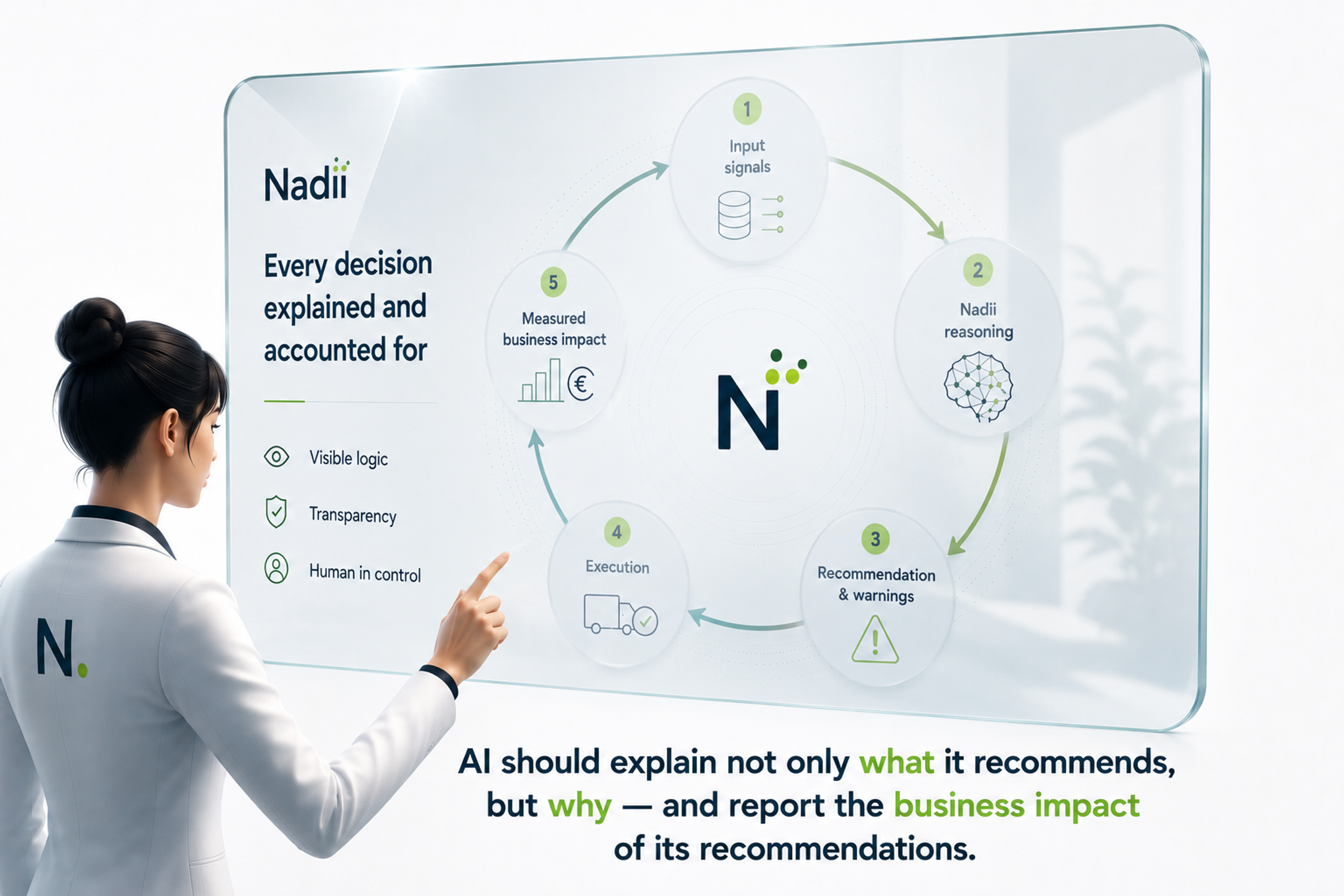
That is why adding a footnote with “AI can make mistakes, please check the result” is not a serious control mechanism in this context. Users cannot check everything. Managers cannot reconstruct every calculation. Teams cannot manually audit every line before execution. If the system is unsure, if the data is abnormal, if the business impact is high, or if the recommendation breaks from the usual pattern, the AI must say so clearly — before the decision creates a problem in the business.
Trust in AI cannot be granted by default; it has to be earned. Nadii is built around that principle. The system does not only generate recommendations: it shows the logic behind them, exposes uncertainty, flags decisions that require attention, documents human overrides and gives teams a shared view of what is happening. Routine decisions can be automated because the risky ones are made visible. Users stay in control not by checking everything, but by knowing exactly where their attention is needed.
In this way, AI does not become a black box operating next to the organisation. It becomes a controlled operating layer: powerful enough to automate decisions at scale, transparent enough to explain them, and cautious enough to warn users when automation should slow down, ask for confirmation or involve a human decision.
Explainable AI: not only recommendations, but rationale
Nadii does not stop at a recommendation such as “order / do not order” or “reallocate / do not reallocate.” Users can see what drives the decision: projected demand, uncertainty, cost of stockout, cost of excess inventory, and the impact on budget, transport, warehouse operations, and service level. This matters most in environments where one decision affects several functions at once and teams need to understand not only the outcome, but also the reasoning behind it.
Human override only where it adds value
Not every decision requires manual intervention, and not every intervention improves the result. Nadii automates repetitive decisions and involves people where a real exception, uncertainty, or need for clarification appears. When the system detects lines that require attention, it flags them clearly with comments such as “check”, so users can focus on the few decisions that need review instead of manually screening everything. Operational teams can also define lists or groups of products, channels, or situations they want to manage in semi-automatic mode — for example, always reviewing Nadii’s proposal before approval. This keeps human control where it genuinely adds value, while the rest of the process runs automatically and consistently within the same decision logic.
Actionable reports – not another set of KPIs
Reports in Nadii do not stop at showing that performance is below plan. Their role is to explain what the result is made of and which operational factors created it: whether the issue comes from forecast error, supplier delay, an oversized buffer, an incorrect reservation, a warehouse constraint, a manual user change, or a deliberate buying decision such as smart buying. The system also shows the structure of inventory and its cost — how much of the stock comes from display stock, minimum availability rules, safety buffers, channel reservations, campaigns, or purchases made intentionally to secure better margin. This means users do not only see that inventory is high; they can also see whether it is true excess stock or a conscious business choice. Reports also show the impact of these decisions on margin, P&L, cash flow, and availability, and allow before/after comparison, so reporting becomes a decision tool rather than another KPI table that still needs interpretation outside the system.
Align team on common decisions based on total cost, not isolated metrics
In many organisations, procurement, sales, logistics, and finance optimise different targets and end up pulling in different directions. Nadii brings these decisions into one logic: the same system weighs availability, inventory, margin, transport cost, operating cost, and cash impact at the same time. This means teams do not need to reconcile conflicting priorities after the fact — they work from the same decision model and the same version of reality.
Automated data cleaning & anomaly detection
A large share of operational problems starts not with a bad decision, but with bad data: missing values, duplicates, anomalies, one-off spikes, wrong lead times, or events that should not be treated as normal demand. Nadii automatically cleans and interprets data before using it in forecasts and recommendations. This reduces manual preparation work and allows decision models to run on a more stable and reliable signal.
Audit trail and before/after comparison
Every change in Nadii leaves a trace: who changed the decision, when, and why. This is important not only for control, but also for organisational learning. Teams can compare outcomes before and after a policy change, a user override, or a parameter update and see whether the intervention actually improved availability, inventory, margin, or operational load. This is especially valuable in environments where decisions are frequent, distributed, and hard to reconstruct later.
Let's talk!
Leave your details and we’ll get back to you within 24 hours to arrange a short online meeting (around 20–30 minutes). You can also tell us what you need straight away, and we’ll tailor the conversation to your situation.
Would you rather email us?
Email us at contact@nadii.io