
Warehouse, Transport & Inventory Management
Warehouse and transport costs can represent a significant share of total supply chain cost. When making movement or ordering decisions, we often need to make trade-offs : increase handling or transport efforts to keep responsiveness high and inventory low, or order more at once to optimize handling and transports costs at the expense of inventory level and low responsiveness.
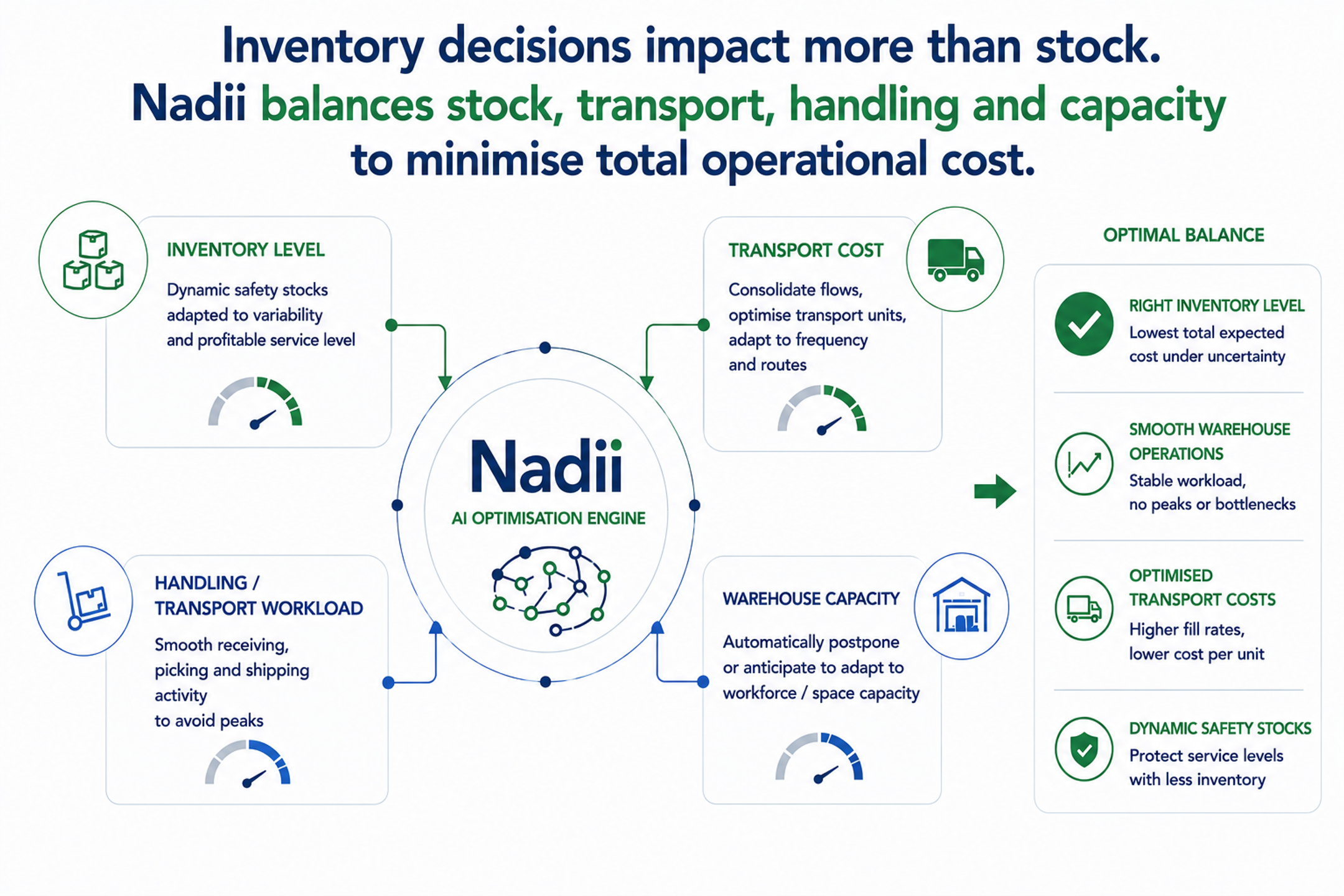
In practice, stock level, shipment rhythm, handling effort, transport cost, and warehouse workload are tightly connected. At the warehouse level and each node of your network, Nadii links these dimensions in one decision logic, measuring costs, so the business can hold the right stock, move it in the right way, and avoid creating operational peaks just to improve one inventory metric. While network design decides where stock should sit across the network, this layer focuses on how inventory decisions can be executed smoothly inside warehouse and transport operations.
Reaching the right inventory level, not the highest/lowest one
Nadii does not aim to maximise/minimize stock. It aims to reach the inventory level that best supports margin (via service level), cash flow, and operational feasibility at the same time. This means the system weighs the cost of stockouts against the cost of excess stock, storage, transport, handling, and working capital. As a result, inventory is managed as a business decision, not as a simple more-stock-means-more-safety rule.
Dynamic inventory minimums and buffers
Nadii does not rely on one fixed minimum or one static safety stock rule. Uncertainty varies with time, season and other external factors like geopolitics, so inventory minimums and buffers should be adapted continuously. Nadii updates them everyday, by SKU and location based on demand behaviour, supply risk, lead times, product criticality, and operating cost. This allows the business to protect availability where the risk is real, while avoiding the habit of protecting every item in the same way regardless of how it actually behaves.
Shipment consolidation and transport optimisation
Nadii connects inventory decisions with transport logic. It consolidates orders and flows into full logistical units where possible, takes into account MOQ, packaging rules, routes, and transport constraints, and helps avoid empty space in shipments or unnecessary emergency moves. This means lower transport cost per unit, better use of freight capacity, and replenishment decisions that are aligned with how the network actually moves goods.
Warehouse workload, handling, and capacity built into decisions
Nadii includes warehouse reality directly in the decision process. It considers inbound and outbound workload, handling effort, warehouse capacity, and the operational consequences of shipment timing. These conditions are recalculated continuously as orders, arrivals, and priorities change, so the business avoids situations where an order looks optimal financially but creates congestion, overload, or unnecessary work in execution. Instead of treating warehouse capacity as a separate afterthought, the system builds it into the recommendation itself.
Inventory decisions that do not overload operations
Nadii is designed to protect service without pushing unnecessary stress into operations. It helps smooth receiving, shipping, and replenishment flows over time, so the company avoids avoidable peaks, expedites, and last-minute corrections. In practice, inventory decisions are not only evaluated by stock level, but also by their impact on workload, transport rhythm, and execution stability. The result is a supply chain that stays more predictable under real operating conditions.
Let's talk!
Leave your details and we’ll get back to you within 24 hours to arrange a short online meeting (around 20–30 minutes). You can also tell us what you need straight away, and we’ll tailor the conversation to your situation.
Would you rather email us?
Email us at contact@nadii.io