
Demand Forecasting & Forecast Performance Control
Forecasts are never perfectly right — and in business, that is not the real problem. The real problem is not knowing which forecast errors matter, how much they cost, and how they should change operational decisions.
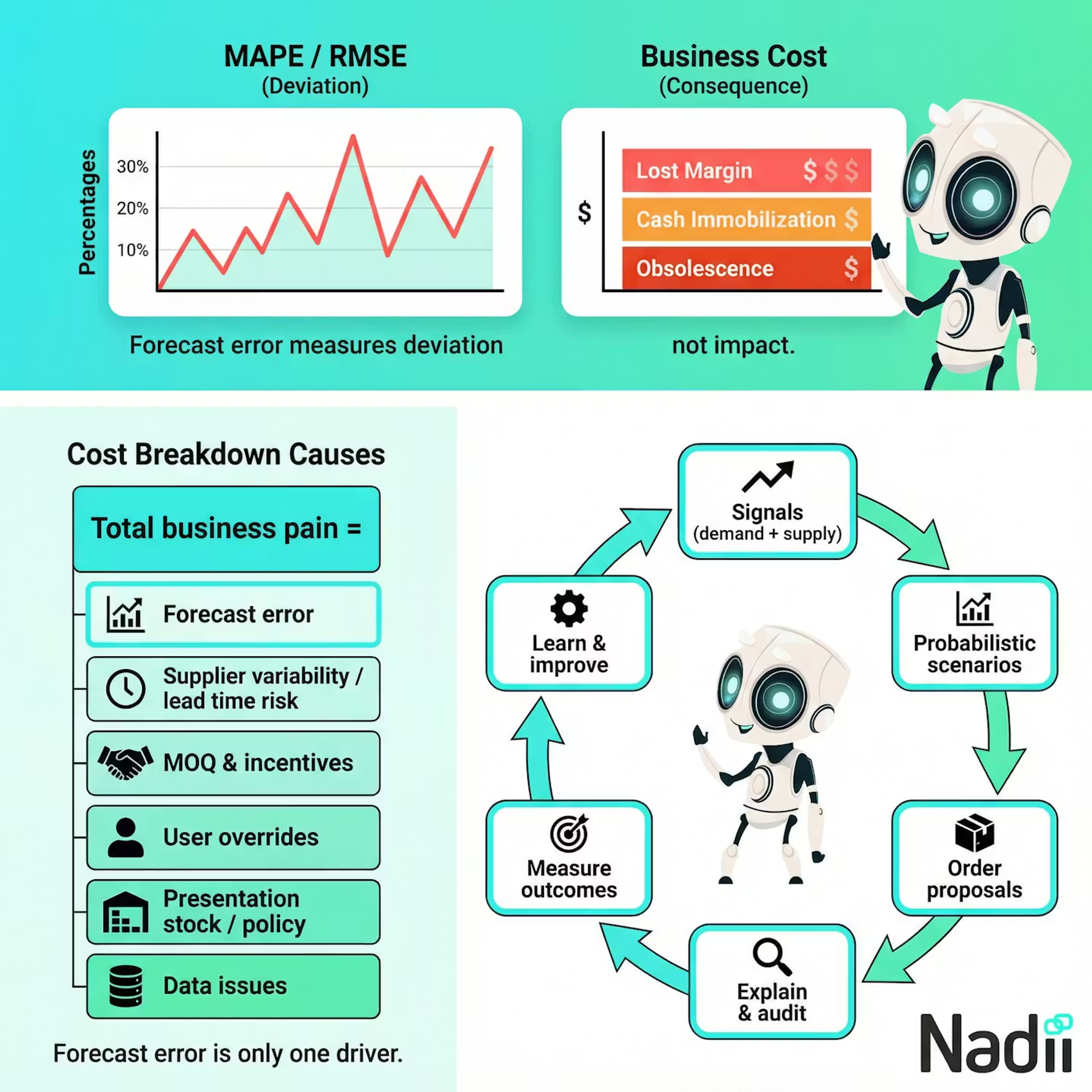
Nadii does not treat forecasting as the search for one perfect number. It treats forecasting as the starting point of a decision system. In practice, demand signals are noisy: seasonality, promotions, price changes, customer behaviour, market events, and channel-specific dynamics all distort the picture. Nadii’s AI models are state-of-the-art and designed by our award-winning Kaggle Grandmaster, they understand the influence of factors, but alone this is not enough to really help your company make the best decisions.
Nadii turns that complexity into usable decision support by combining probabilistic forecasting, automated data preparation, and a direct link between forecast quality and business outcomes such as inventory, availability, margin, and cash. Forecasts are built at the level where decisions are actually made — by SKU, location, and channel — and in the short term Nadii can combine confirmed orders and reservations with probabilistic forecasting to reflect what is already committed and what still remains uncertain.
The goal is not only better forecasts. The goal is better decisions under uncertainty.
Uncertainty included in every decision
Most companies still organise planning around one forecast value: one number per product, per period, per location or per channel. But operational decisions are not made in a certain world. They are made under risk. The same median forecast can lead to very different decisions depending on the probability of higher demand, the cost of a shortage, the cost of excess stock and the ability to react later.
Nadii works with uncertainty directly. For each SKU, location, channel or aggregation level, the system can consider a range of possible demand outcomes rather than a single number. It distinguishes products with stable behaviour from products exposed to volatility, seasonality, incomplete information or campaign effects. This uncertainty is then used in the decision logic: stock buffers, replenishment intensity, production timing, reservation rules and risk tolerance can all adapt to the real behaviour and business importance of each item.
This changes the role of forecasting. Instead of asking only “what will demand be?”, Nadii helps answer “what decision should we make given what demand could be, how likely each scenario is, and what each error would cost?”. This is particularly important for long lead time products, high-value items, strategic customers, scarce components and seasonal ranges, where the financial consequences of being wrong are asymmetric.
Understanding the impact of special channels, events or constraints
Many demand signals are not random. They are shaped by deterministic business factors: promotions, discounts, advertising, price changes, product visibility, marketplace ranking, weather, local events, new contracts, distribution changes, assortment decisions or customer-specific behaviours. If these effects are not identified, the model may interpret an event as normal demand, or treat a repeatable pattern as noise.
Nadii helps separate the underlying demand signal from the factors that influence it. The system can include business drivers such as campaigns, price changes, promotional calendars, channel dynamics, customer priorities, product positioning, weather or operational constraints. This allows teams to understand not only how much demand is expected, but also why demand is changing and which factors are driving it.
This matters because the same product may behave differently depending on the channel or business context. E-commerce demand may react to online visibility, paid campaigns or delivery cost. Retail demand may depend on store exposure, promotions or local events. B2B demand may depend on contract commitments, ordering cycles or strategic customers. Nadii can analyse these effects at the relevant level — product, group, location, channel or customer — so forecasting reflects the way the business actually works.
Forecasting and S&OP
Forecasting does not serve only short-term replenishment. It also supports budget planning, S&OP, capacity planning, purchasing strategy and investment decisions. But these decisions do not require the same forecast horizon, aggregation level or modelling logic. A daily SKU-level forecast for execution is not the same as a monthly category forecast for budget planning, and a short-term model enriched with promotions or prices may not be appropriate for a six-month scenario where these inputs are still uncertain.
Nadii allows forecasting to work at different horizons and aggregation levels, usually with separate models : per product, product group, location, channel, customer segment, supplier family or business unit. This makes it possible to support both operational decisions and higher-level planning without forcing all use cases into one universal forecast. Short-term decisions can use detailed operational signals, while medium- and long-term planning can rely on aggregated scenarios, assumptions and probability ranges.
This is especially useful in S&OP contexts where the company must plan for scenarios that are not necessarily the most probable ones or highly uncertain : opening a new market, launching a new product, preparing for a geopolitical disruption, reserving capacity for growth, or securing strategic raw materials. Nadii can connect those demand scenarios to real operational consequences: inventory needs, supplier commitments, production capacity, cash flow, warehouse workload and service levels. The scenario chosen at S&OP level can then be translated into daily replenishment, purchasing and production decisions, instead of remaining a high-level planning assumption disconnected from execution.
Data cleaning / understanding before forecasting
A forecast is only as reliable as the signal it learns from. In real operations, data is rarely clean: one-off spikes, stockouts, missing values, duplicated transactions, abnormal orders, campaign effects, price changes, supply disruptions or manual corrections can all distort the historical signal. If these anomalies are not handled properly, even a strong algorithm will learn the wrong pattern and produce recommendations that look mathematically consistent but operationally misleading.
Nadii automatically detects and prepares data before forecasting. The system identifies abnormal demand, missing values, distorted sales histories and events that should not be treated as normal recurring behaviour.
When part of the demand is already known in advance — for example confirmed orders, reservations or backlog — Nadii distinguishes deterministic demand from forecasted demand. Firm short-term demand can therefore be used directly, while probabilistic forecasting is applied to the horizons where uncertainty remains.It can distinguish between true demand changes and signals caused by temporary events, operational constraints or data quality issues. This reduces manual preparation work and makes forecasting scalable across thousands or millions of SKU-location combinations.
The objective is not to hide complexity, but to make the signal usable. Nadii monitors the quality of input data and adapts models as conditions evolve, while warning users when the data becomes too abnormal or incomplete to support reliable decisions without attention. This is essential in environments where teams cannot manually inspect every product before every planning cycle.
Controlling forecast accuracy and financial impact
Forecast control should not stop at statistical accuracy. A forecast can be mathematically wrong but financially harmless, or statistically acceptable while creating serious business damage on a few critical products. What matters is to connect forecast errors to their operational and financial consequences.
Nadii monitors forecast performance and links it to the decisions and outcomes it influenced. If a forecast was too low, the system can show whether it contributed to lost sales, lower service level, emergency shipments, production disruption or margin loss. If a forecast was too high, it can show whether it created excess stock, higher warehousing cost, cash immobilisation, markdown risk or unnecessary purchasing. Forecast error is therefore analysed as one cause of performance among others — alongside supplier unreliability, MOQ constraints, smart buying decisions, user overrides, presentation stock, operational bottlenecks or channel reservations.
This makes forecasting transparent and actionable. Users do not only see that the forecast was wrong; they understand where the error mattered, how much it cost, and whether improving the model would really create value. In some cases, the priority may be to improve forecast precision for a specific product group. In others, the bigger business impact may come from reducing supplier variability, shortening lead times, changing purchasing rules or reviewing manual overrides. Nadii helps teams focus on the source of financial impact, not only on the forecast metric.
Let's talk!
Leave your details and we’ll get back to you within 24 hours to arrange a short online meeting (around 20–30 minutes). You can also tell us what you need straight away, and we’ll tailor the conversation to your situation.
Would you rather email us?
Email us at contact@nadii.io