
Automated Replenishment & Profit-Based Decisions
As soon as a business manages more than 100 products, replenishment stops being a task that humans can optimise accurately by intuition, Excel rules, or simple stock coverage targets. The difficulty is not only the number of SKUs. It is the number of details that should influence every decision: uncertain demand, supplier reliability, MOQ and packaging constraints, price changes, discount thresholds, smart buying opportunities, transport and warehousing costs, cash tied in inventory, service-level targets, and the fact that each product has a different role in the portfolio.
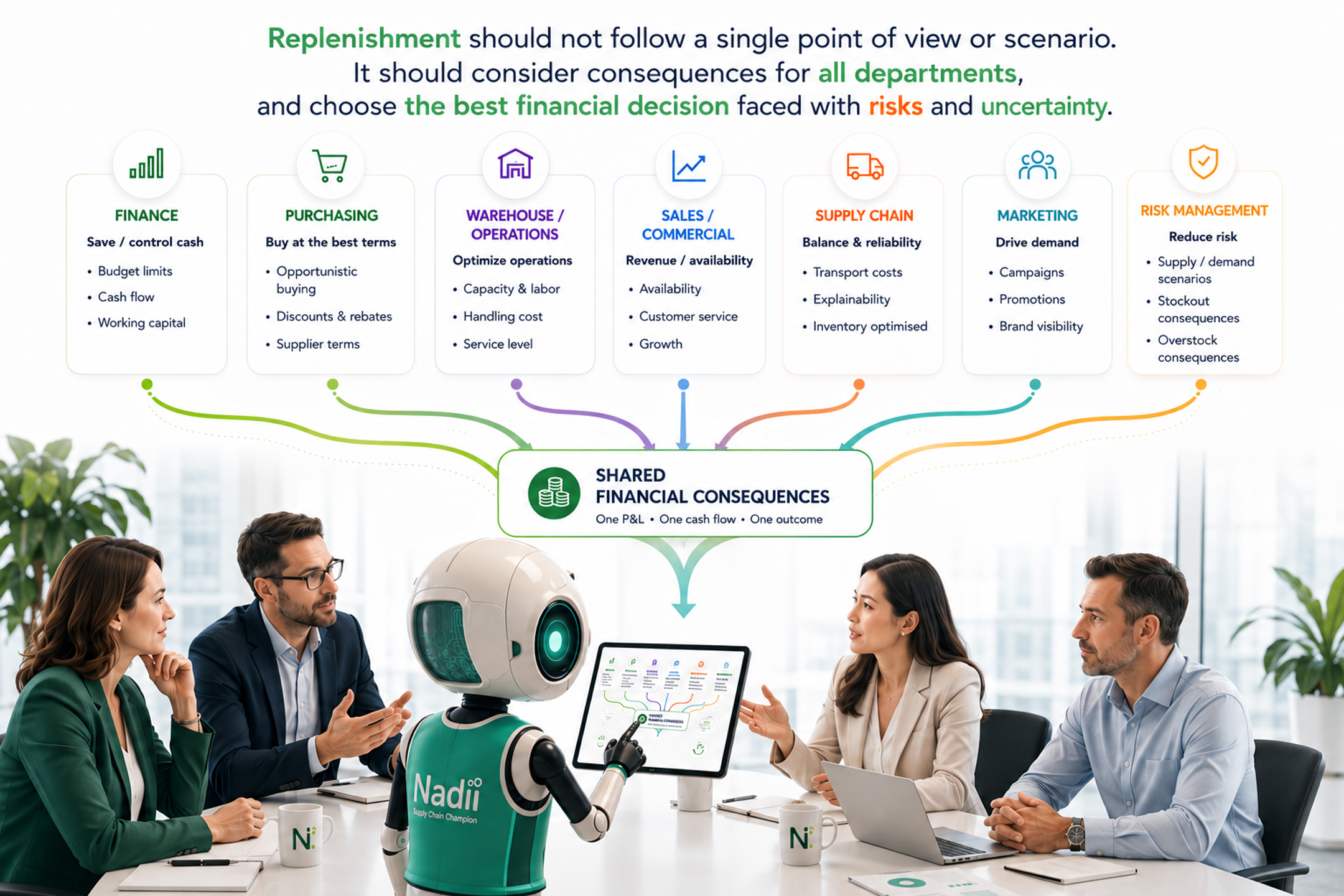
At that scale, the real question becomes: “on what basis can we say that one decision is better than another?” Buying more may secure availability but destroy cash flow. Buying less may reduce stock but create lost sales. Accepting a supplier discount may improve unit margin, or it may only create overstock. A high buffer may protect a strategic product, while the same buffer on a slow mover may quietly erode profit through storage cost, depreciation and frozen capital.
Nadii answers this question with the metric that matters: the long-term financial impact of each decision, faced with different risks. Instead of optimising replenishment around isolated indicators such as stock coverage, purchase price or service level, Nadii evaluates decisions against multiple demand and supply scenarios and their financial consequences. Nadii turns replenishment into a decision system that weighs demand, supply, costs, operational constraints and business priorities at the same time. In practice, this means the system decides not only how much to order, but also when to order, from whom, for which location or channel, under which constraints, and with what expected operational and financial impact.
Decisions based on total cost, not isolated metrics
Nadii does not optimise replenishment around a single KPI such as stock coverage, purchase price, or service level in isolation. Each decision is evaluated against the broader business trade-off: cost of stockout, cost of excess stock, transport cost, handling effort, working capital impact, and operational feasibility. This is especially useful when improving one local metric would actually damage overall performance elsewhere in the network.
Supplier constraints, incentives, and trade terms under control
Replenishment decisions often depend on supplier realities: MOQ, MPQ, threshold discounts, quarterly targets, packaging rules, transport tariffs, contract conditions, and lead time reliability. Nadii incorporates these constraints directly into the decision logic, so buyers do not have to manually recalculate what is operationally valid and what is commercially attractive. This helps companies avoid buying “for the supplier’s conditions” instead of for their own business outcome.
Long lead time and overseas supply under control
When supply is stretched over weeks or months, small mistakes in timing or quantity become expensive: emergency shipments, missed launches, excess stock in transit, or misaligned container utilisation. Nadii continuously recalculates needs against updated sales, supplier timings, shipping calendars, and logistics constraints, so overseas and long lead time supply is managed as a moving decision process rather than a one-off order plan.
Smart buying driven by business outcomes
Buying more is not always smart, even when the unit price looks attractive. Nadii evaluates whether a discount, promotional deal, or supplier offer actually improves the business result once capital lock-up, excess stock risk, freight, and demand uncertainty are taken into account. This allows teams to distinguish between a purchase that improves margin and one that only inflates inventory.
Different policies for different products, channels, and customers
Not every SKU should be planned and managed in the same way. Nadii analyses each item in the context of a specific location, channel, and, when needed, a specific customer or customer group. This means each SKU can have its own forecast, its own view of variability, seasonality, sales pattern, required service level, and supply risk in that exact context. As a result, one item may run with a higher buffer, another on demand, and another with a reservation for a specific channel or strategic customer — always based on its actual behaviour rather than on one averaged rule applied across the whole assortment.
Network-wide replenishment, not siloed decisions
Nadii treats the network as one system rather than a set of disconnected locations. Before suggesting a purchase, it can evaluate whether stock already exists elsewhere in the network and whether reallocation would be faster, cheaper, or operationally safer. This is particularly valuable in multi-warehouse, multi-store, hospital, or omnichannel environments where local replenishment decisions easily create excess in one place and shortages in another.
Promotions and pricing connected to inventory decisions
Promotions, markdowns, price changes, and campaign calendars should not sit outside replenishment logic. Nadii links these demand drivers directly to inventory decisions, so the system can prepare stock before a campaign, adjust replenishment during the sales peak, and avoid over-ordering after the promotion ends. This is especially important in retail and e-commerce, where the cost of being unavailable during a campaign is high, but the cost of overstock after it ends is just as real.
Being able to override AI decisions and measure the impact
Operational teams still need room for intervention when information outside the system matters: a customer escalation, a product launch, a local event, or a strategic decision. Nadii allows users to override recommendations where needed while keeping the change fully measurable and traceable. This makes it possible to compare what the system proposed, what the user changed, and how that change affected inventory, availability, margin, or operational workload. Each such intervention is then tracked, analysed, and reported, so users can also assess their decision afterwards against Nadii’s original recommendation and verify whether the override actually improved the outcome.
Transport, warehousing, and handling included in the decision
Replenishment should not be disconnected from execution. Nadii considers warehouse capacity, inbound and outbound workload, handling effort, shipment consolidation, transport cost, and delivery rhythm when making replenishment decisions. This helps prevent a situation where an order is financially “optimal” on paper but creates peaks, congestion, or unnecessary cost in the warehouse and transport flow.
Dynamic ordering calendar
Nadii follows the customer’s ordering calendar, but it does not passively wait for the next scheduled order date. The system keeps recalculating needs in the background so it can detect the risk of lost sales, stockouts, or delays early and warn the user that, even if the calendar suggests ordering in a few days, action may be needed today. At the same time, Nadii can recommend a more efficient ordering calendar based on demand behaviour, lead times, supplier constraints, and the rhythm of operations. Whatever calendar is in place, the system continues to monitor the situation and sends alerts whenever earlier action becomes necessary.
Ordering within budget, cash flow, and inventory caps
Replenishment is rarely unconstrained. Nadii can operate inside purchasing budgets, inventory caps, cash flow targets, and category-level or company-level limits. Instead of forcing finance targets to be managed outside the replenishment process, the system embeds them in the daily decision logic, so orders remain consistent with both operational needs and financial boundaries.
Let's talk!
Leave your details and we’ll get back to you within 24 hours to arrange a short online meeting (around 20–30 minutes). You can also tell us what you need straight away, and we’ll tailor the conversation to your situation.
Would you rather email us?
Email us at contact@nadii.io