
Supply Forecasting
Suppliers sometimes deliver exactly as planned — but in real life, plans are easily disrupted. Lead times shift, deliveries arrive partially, service levels vary, availability changes, and risk often increases long before a stockout becomes visible in the ERP. The impact of those disruptions on sales, inventory, cash and service level can easily exceed the impact of demand variability. So why do most systems still treat supply as if lead time were a fixed parameter?
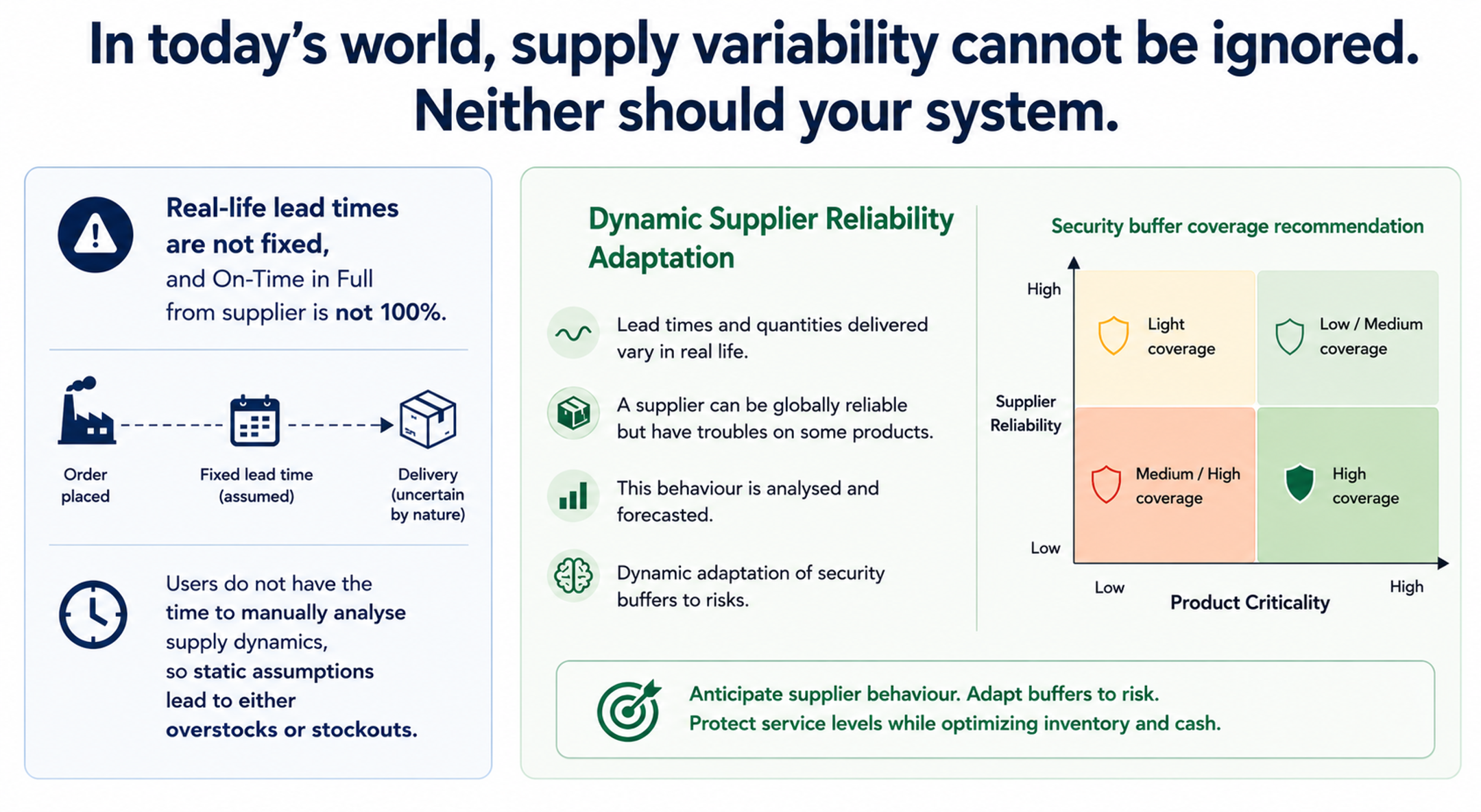
In practice, a company can have a good demand forecast and still make poor decisions if supplier behaviour is not forecasted with the same level of attention. Ordering too late from an unreliable supplier may create shortages, emergency transport and lost margin. Ordering too early or too much to protect against uncertainty may create excess stock, frozen cash and higher warehousing costs. The real challenge is therefore not only to know what demand may be, but also to understand whether supply will arrive on time, in full, and with what level of risk.
Nadii turns supply uncertainty into operational decisions. It forecasts supplier behaviour, works with probabilistic lead times and service levels, and links supply risk directly to inventory, ordering, execution logic and realistic ETA windows. This allows the system to protect the business against unreliable supply without blindly inflating stock everywhere.
Supplier behaviour and lead time variability included
Nadii forecasts supply by analysing how suppliers actually perform over time: changing lead times, delivery variability, partial deliveries, service levels, route behaviour, contract execution and market-driven disruptions. Instead of assuming one fixed replenishment delay, the system learns from historical supplier behaviour and continuously updates its view of expected delivery timing and reliability.
This makes supply planning more realistic, especially where the same product behaves very differently depending on the supplier, source, contract, country, route or transport mode. A supplier that is reliable for one family may be unstable for another. A lead time that looks acceptable on average may hide a high probability of delay at exactly the moment when the business cannot afford it. Nadii captures those differences and turns them into planning logic.
Uncertainty included in every decision
Nadii does not treat supply as a single promised date or quantity. It works with uncertainty around delivery timing, supplier reliability and expected quantities, and uses that uncertainty directly in decisions about buffers, order timing, allocation, replenishment intensity and execution priorities.
This means the system can respond differently to a reliable source than to a volatile one, without applying the same safety logic everywhere. The level of protection also depends on the role of the product in the portfolio: a low-runner replacement product should not be protected in the same way as a flagship product, a critical component, a campaign item or a strategic customer commitment.
The result is better protection against supply risk without automatically increasing inventory across the board. Nadii can decide when additional stock is justified, when the risk can be accepted, when an earlier order is enough, when a second source should be considered, or when inventory should be reallocated before placing a new purchase.
Early warning when supply risk increases
Supply risk rarely appears suddenly. It usually starts with weak signals: a supplier becomes less stable, lead time variability increases, partial deliveries become more frequent, contract consumption accelerates, or confirmed deliveries drift away from the original plan. In many companies, those signals are noticed only when the shortage is already close.
Nadii is designed to detect these changes early and turn them into action. When supplier behaviour deteriorates, expected availability becomes less reliable or the risk of future shortage rises, the system generates warnings and proposes corrective decisions. Depending on the context, that may mean ordering earlier, adjusting buffers, switching source, reallocating stock, preparing an alternative path, proposing a contract annex or protecting only the products and channels where the risk really matters.
This gives teams time to react while options still exist. Instead of discovering the problem when execution is already under pressure, the business can anticipate supplier risk and decide how much protection is financially justified.
From forecast accuracy to operational decisions
Nadii does not stop at measuring how accurate a supply forecast was. The supply forecast becomes part of one operational decision chain: when to order, how much to protect, whether to reallocate, whether to switch supplier, how to set buffers, and how to plan receiving, production and execution.
In practice, supply forecasting helps the business avoid both underreaction and overreaction. Underreaction creates shortages, lost sales, emergency purchasing, expedited transport and operational disruption. Overreaction creates excess stock, higher warehousing cost, frozen cash and unnecessary purchasing. Nadii evaluates both sides of the risk and links each decision to its expected cost, service impact and operational feasibility.
This is especially important when management needs to understand why inventory is being kept. If additional stock is maintained to protect against unreliable supply, Nadii can report the reason and the cost of that protection: which supplier risk it covers, which shortage it is meant to avoid, which products or channels it protects, and how much capital is tied up as a result. This makes protective inventory visible as a conscious business decision, not an unexplained stock increase.
As a result, teams work with realistic ETA windows instead of one artificial promised date, better ordering timing, fewer emergency moves and supply decisions aligned with cost, service, cash and operational capacity.
Let's talk!
Leave your details and we’ll get back to you within 24 hours to arrange a short online meeting (around 20–30 minutes). You can also tell us what you need straight away, and we’ll tailor the conversation to your situation.
Would you rather email us?
Email us at contact@nadii.io